
By Bryan Hansen
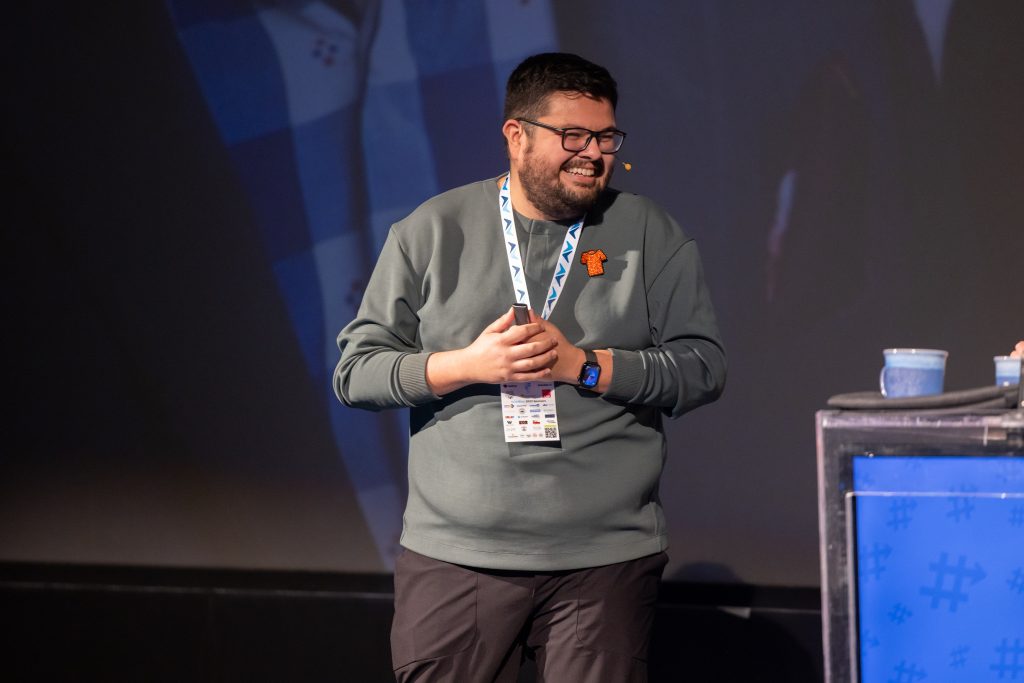
Ben Borne is much more than a communications professional – he’s a genuine connector of people and ideas. A member of Yellow Quill First Nation now based in Saskatoon, Saskatchewan, Borne is making waves through is work with Symmetry Public Relations and his teaching roles at universities like the First Nations University of Canada and the Simon Fraser University.
After studying in Winnipeg, Borne returned to Saskatoon and has spent over a decade diving deep into the communications world. “I’ve been involved in various roles in this realm ever since,” he shares. His educational journey is diverse, including a Bachelor of Arts from Canadian Mennonite University, a Diploma in Public Relations from the University of Victoria, and a Master of Arts in Professional Communication from Royal Roads University, where he was honoured with the Founders Award for his leadership and commitment to equity.
Borne’s personal history is deeply intertwined with his professional journey. His mother was a Sixties Scoop baby, “taken from her reserve by social workers and raised by a German Mennonite family in Saskatoon,” he explains. He speaks of his journey of reconnecting with his identity and understanding the impacts of historical trauma and harm. “Over the last decade, through my work and personal reflection, I’ve been on a journey of reconnecting with my identity and understanding the impacts of historical trauma and harm,” he shares. This personal experience influences his commitment to both reconciliation and empowerment of Indigenous communities.
When it comes to the future of Indigenous communities and the potential of fully realizing Truth and Reconciliation, Borne doesn’t shy away from big ideas. “It’s a powerful thought exercise,” he says. “When discussing Truth and Reconciliation, people often feel overwhelmed by the fear of paradigm shifts, especially around changing economic and social structures. What we need is a clear vision of what ‘done’ looks like – what does a fully reconciled society actually entail?”
Borne is keen on exploring these “what ifs.” “What if Indigenous people had equitable access to education and healthcare or comprehensive resolutions to land rights? These are big ‘what ifs,’ but imagining them can help guide our actions today.”
For Borne, real reconciliation starts with tangible changes like land ownership and integration of traditional values. “A starting point would be genuine land ownership for example.” He explains that reserve lands are often Crown land, which limits their economic value. “If we had the right to our own land and use it for economic opportunities like businesses, investments, or infrastructure development, it would fundamentally change the game.”
The Indian Act, a piece of legislation that has governed First Nations’ lands and resources since 1876, stands as a significant barrier to this kind of economic empowerment. “The Indian Act imposes restrictions that limit the economic potential of these reserve lands,” Borne points out. “Reserves are often considered Crown land, which means First Nations don’t have the same rights as other landowners to leverage their property for economic growth.”
Borne advocates for changes that would allow Indigenous communities to fully control their land. “Imagine if Indigenous communities could own land outright, without the constraints of The Indian Act,” he suggests. “We could develop businesses, build infrastructure, and attract investments in a way that aligns with our values and needs, rather than being limited by outdated regulations.”
He emphasizes that land ownership is not just about economic gain but also about reclaiming agency and sovereignty. “It’s about having the freedom to manage our resources and shape our economic future on our terms,” Borne adds. “True reconciliation involves dismantling these restrictive frameworks and allowing Indigenous peoples to thrive independently and sustainably.”
Borne’s perspective on Indigenous business practices offers a fresh lens on wealth and economic sustainability. “Indigenous businesses often balance economic goals with social and cultural objectives,” he says. “It’s about creating wealth and then redistributing it within the community to support social well-being, like funding community programs or investing in education and health.”
This approach contrasts starkly with mainstream practices that typically focus on profit maximization and wealth accumulation. “Indigenous businesses operate within a framework that integrates traditional values with economic activities,” Borne elaborates. “It’s a circular economy where resources are constantly reinvested into the community rather than hoarded or accumulated in one place.”
He highlights how this model offers a more holistic view of wealth. “The focus is on sharing, community building, and connection,” Borne says. “Wealth isn’t just about financial gain; it’s also about knowledge, culture, and the health of the community.” This approach is engrained in Indigenous worldviews, where the well-being of the community and future generations is prioritized.
Borne also emphasizes the importance of supporting and growing Indigenous-led businesses. “When Indigenous businesses reinvest their earnings back into the community – whether it’s through funding local development projects or supporting youth programs – they’re contributing to a sustainable and resilient economy,” he notes. “It’s about creating long-term value and ensuring that the benefits of economic activities are widely shared.”
For Borne, education is a cornerstone of building Indigenous workforce capacity. “Many First Nations are already investing heavily in on-reserve education to build capacity from within,” he notes. He points to initiatives like his own Nation’s efforts to create housing for teachers as a model for sustainable development. “There’s also a push towards Indigenous-led post-secondary institutions like First Nations University of Canada,” he says, envisioning a future where such institutions can train Indigenous students on their own terms. He also advocates strongly for professional development programs that support Indigenous professionals, adding, “It’s about empowering communities to manage their own futures and create meaningful opportunities for their members.”
Looking forward, Borne envisions a future where reconciliation translates into tangible benefits for Indigenous communities. “It’s about achieving genuine economic empowerment, social justice, and equity. Imagine if land and resource rights were fully honoured, infrastructure on reserves was state-of-the-art, and education and healthcare were equitable and culturally appropriate.”
Borne acknowledges that this vision requires equal measures of imagination and action. “Reconciliation is the work of settlers… reconciling what they thought was true with what is actually true,” he says. For Indigenous people, it’s about cultural revitalization and asserting sovereignty in every aspect of life.
“It’s a vision we need to work towards collectively, recognizing the unique roles and responsibilities each of us has in making it a reality,” Borne concludes. His perspective challenges us to think big and act boldly, moving towards a future where reconciliation is not just a concept, but a reality that we all have a part in creating.